
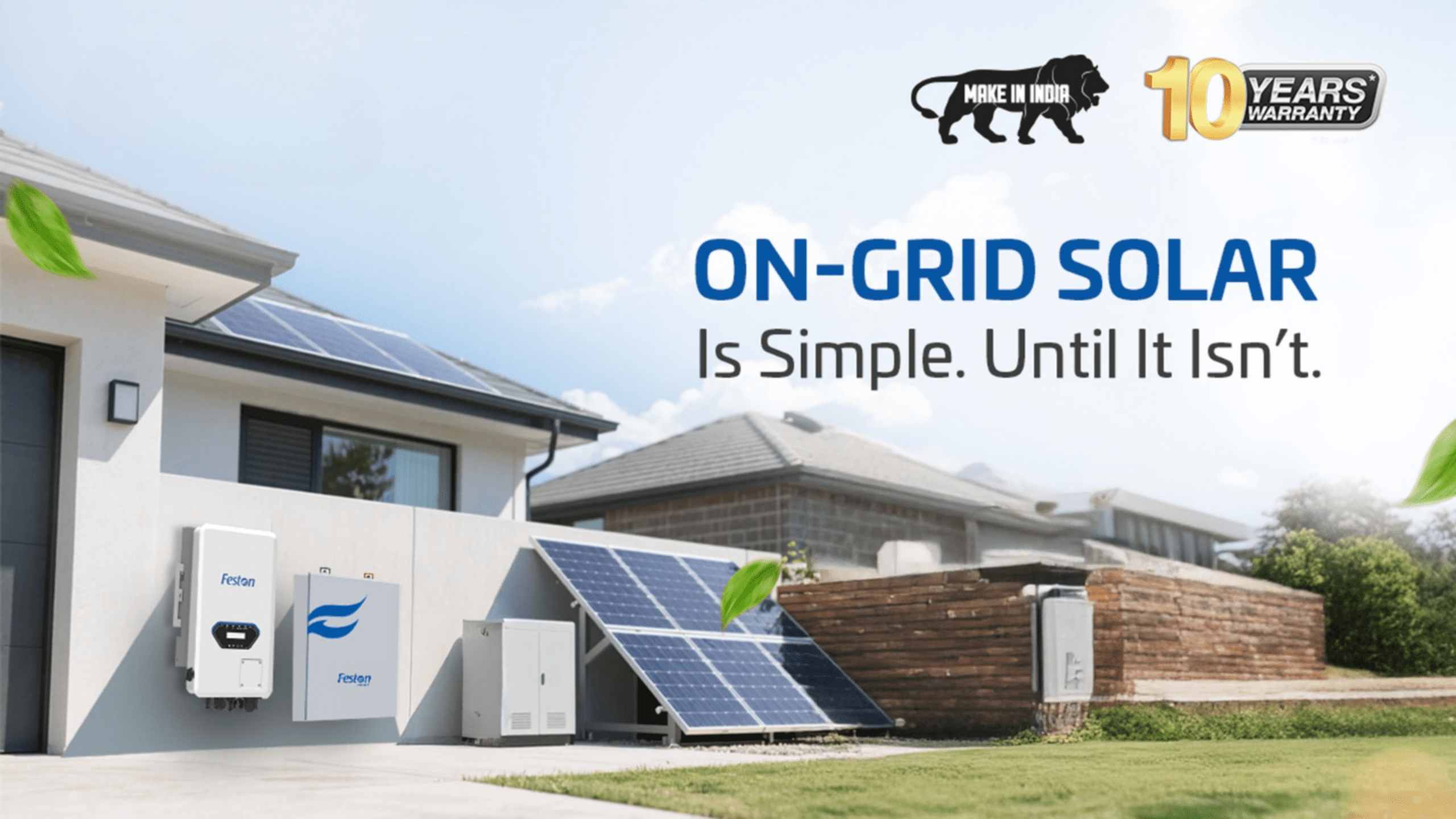
On-Grid Solar Is Simple. Until It Isn’t.
Who This Article Is For
This article is written for rooftop solar EPCs, installers, and system integrators working on on-grid residential and small commercial projects in India.
On-grid solar systems often appear simple at the time of installation. Panels generate power, inverters synchronise with the grid, and surplus energy is exported. On paper, the process looks straightforward.
In reality, complexity begins after commissioning.
Once a rooftop system starts interacting with the local electricity grid, real-world conditions such as voltage fluctuations, frequency variation, and feeder congestion begin influencing performance. These factors rarely surface during sales or installation but become visible over time through system behaviour, uptime, and service requirements.
In many Indian cities, on-grid solar issues are not caused by panels or basic system sizing errors. They are primarily driven by grid behaviour that varies by location, time of day, and season. As rooftop density increases, these effects become more pronounced.
This is why on-grid solar reliability is defined less by generation capacity and more by how well inverters and protection systems respond to unstable grid conditions over time.
Key Takeaways
- On-grid solar challenges typically emerge after commissioning, not at installation
- Most rooftop issues are grid-driven, not panel-related
- Voltage fluctuation and feeder congestion increase as rooftop density grows
- Inverter grid compatibility plays a major role in long-term uptime
Why On-Grid Systems Face Challenges After Installation
Most rooftop issues do not originate on the DC side. Solar modules generally perform as expected. The friction appears at the point of grid interaction.
Urban and semi-urban grids frequently operate outside ideal voltage ranges. Load patterns change throughout the day, feeders are shared by multiple rooftop systems, and seasonal demand places additional stress on local distribution infrastructure.
When inverters are not designed to tolerate these variations, systems begin tripping, generation becomes inconsistent, and service calls increase. What initially looked like a stable installation turns into an operational concern.
This is why on-grid solar performance is not defined only by kilowatt sizing or module quality. It is defined by how the system behaves when the grid does not.
The Scaling Effect: When Volume Exposes Weakness
As rooftop adoption increases, grid interaction effects compound.
Higher rooftop density means more systems injecting power into the same distribution network. This amplifies voltage rise issues and increases protection sensitivity. Installers often observe that systems performing well in isolation behave differently once neighbouring rooftops also go solar.
At scale, even small design shortcuts become visible. Protection logic, inverter response behaviour, and grid compatibility begin influencing customer satisfaction as much as generation numbers.
This marks a clear shift in how rooftop solar must be approached.
What This Means for EPCs and Installers
- For EPCs, the challenge is no longer limited to installing faster. It is about installing systems that remain stable long after handover.
- This requires greater attention to inverter behaviour, grid compliance, and long-term serviceability. Choosing platforms that reduce nuisance tripping, tolerate grid variability, and deliver predictable performance across sites is becoming a business necessity.
- As financing and subsidy-driven adoption accelerates, accountability for performance increases across the ecosystem. Customers increasingly expect rooftop systems to operate quietly and consistently, without repeated intervention.
Where the Industry Is Headed
Rooftop solar is increasingly being treated as long-term energy infrastructure rather than a short-term cost-saving measure.
This shift places greater emphasis on standardisation, grid-aware system design, and reliability over the full operating lifecycle. Systems must be built not only for current grid conditions, but also for increasing rooftop density and evolving network behaviour.
Manufacturers and EPCs aligned with this reality will face fewer surprises over time.
Where Feston Fits In
At Feston, inverter design has always prioritised operating stability under real Indian grid conditions.
Rather than optimising only for ideal scenarios, our platforms are engineered to manage grid variability, protection coordination, and consistent long-term performance. As on-grid solar continues to scale, these fundamentals play a defining role in sustaining reliability across installations.
Closing Perspective
On-grid solar systems succeed over time when they are designed for real grid behaviour rather than ideal conditions. As rooftop density increases across India, long-term reliability will depend on grid-aware inverter design, stable protection logic, and predictable system behaviour after commissioning. For EPCs and installers, focusing on lifecycle performance rather than installation simplicity is becoming essential.
Frequently Asked Questions
Why do on-grid solar systems face issues after commissioning?
Because real grid conditions such as voltage fluctuation, frequency variation, and feeder congestion become visible only once the system starts interacting with the local distribution network.
Are most on-grid solar problems caused by panels?
No. In most rooftop systems, post-installation issues are more commonly linked to grid interaction and inverter protection behaviour rather than panel performance.
Why do on-grid solar inverters trip frequently in India?
On-grid solar inverters in India often trip due to voltage fluctuations, frequency variation, and feeder congestion in local distribution networks, especially as rooftop solar density increases.
How does grid behaviour affect rooftop solar performance?
Unstable grids can cause frequent tripping, reduced generation, and higher service requirements, even when systems are correctly designed and installed.
What should EPCs prioritise when selecting on-grid inverters?
Grid tolerance, stable protection logic, predictable behaviour across sites, and dependable after-sales support.
If you are planning or scaling on-grid rooftop projects, now is the time to look beyond installation simplicity and focus on how systems perform over years of operation.
Connect with Feston to explore inverter solutions designed for stable grid interaction and dependable performance.
With Feston, Always On ⚡